
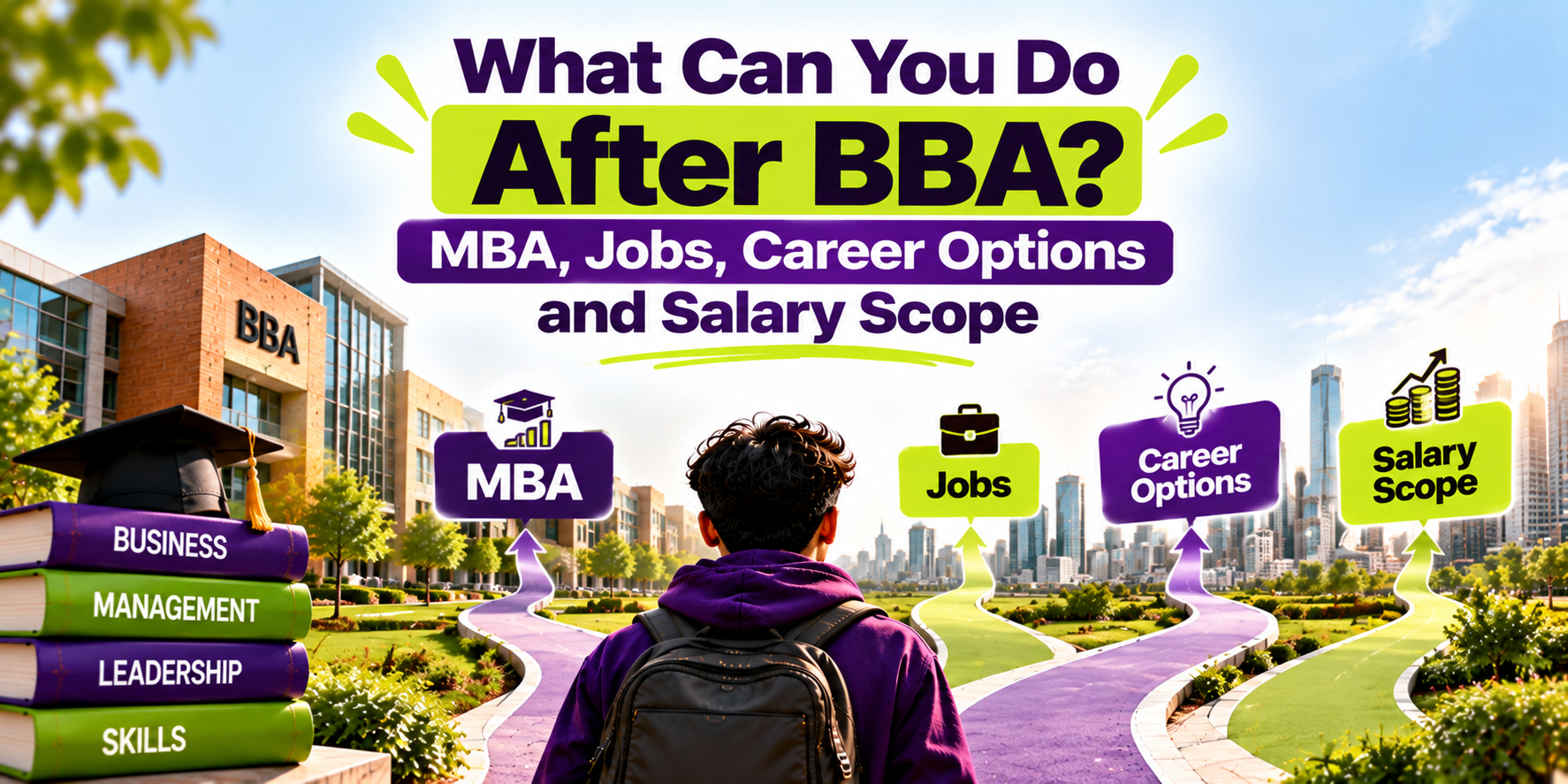
Completing a Bachelor of Business Administration (BBA) gives students a foundation in business, management, finance, marketing, human resources, operations and entrepreneurship. But graduation does not mean there is only one career path ahead.
So, what can you do after BBA?
A BBA graduate can start working immediately, pursue an MBA or another postgraduate degree, prepare for competitive or government examinations, specialise in areas such as digital marketing or business analytics, or even start a business. The right choice depends on your career goals, interests, financial priorities and the skills you want to build.
For students wondering whether to work or study further after BBA, the important point is that there is no single “best” option after BBA. Some students benefit from gaining work experience first, while others choose an MBA immediately to build deeper management expertise.
This guide explains the major career options after BBA, MBA opportunities, popular jobs, salary expectations, skills to develop and long-term career scope.
What Are the Options After BBA?
After completing BBA, students generally have five broad career directions:
- Start a job in the private sector
- Pursue an MBA or another postgraduate programme
- Specialise in a professional or industry-specific field
- Prepare for government and competitive examinations
- Start a business or work on an entrepreneurial venture
The best route depends on whether your immediate priority is earning, higher education, specialisation, professional experience or entrepreneurship.
UGC’s current higher-education framework also emphasises flexible academic pathways and opportunities for learners to choose programmes according to their interests and career trajectories.
Is MBA After BBA a Good Option?
Yes, an MBA can be a strong option after BBA, particularly for students who want to build a career in management, consulting, finance, marketing, HR, operations, product management or business strategy.
A BBA already provides an introduction to management concepts. An MBA can take that foundation further through advanced subjects, specialisation, internships, projects, case studies and industry exposure.
Graduates from a recognised bachelor’s degree can apply to MBA programmes, subject to the eligibility criteria of individual institutions. For example, IIMs commonly require a bachelor’s degree with a minimum percentage or equivalent CGPA, although exact requirements vary by institute and programme.
Which MBA Specialisation Can You Choose After BBA?
The right MBA specialisation depends on your interests and the type of career you want.
MBA in Marketing
MBA Marketing can be suitable for students interested in branding, advertising, sales, consumer behaviour, digital marketing, market research and business development.
Possible career roles include:
- Marketing Manager
- Brand Manager
- Digital Marketing Manager
- Sales Manager
- Business Development Manager
- Market Research Analyst
- Growth Manager
MBA in Finance
Students interested in numbers, financial markets, accounting, investment and corporate finance can consider an MBA in Finance.
Possible career roles include:
- Financial Analyst
- Corporate Finance Analyst
- Investment Banking Analyst
- Credit Analyst
- Financial Planning roles
- Banking and financial services roles
MBA in Human Resources
An MBA in HR can lead to careers involving recruitment, employee development, compensation, performance management and organisational strategy.
Common roles include:
- HR Executive
- Talent Acquisition Specialist
- HR Business Partner
- Learning and Development Specialist
- Compensation and Benefits Specialist
MBA in Operations
Operations-focused programmes can be useful for students interested in supply chains, logistics, process management, production and business operations.
Career opportunities can include:
- Operations Manager
- Supply Chain Analyst
- Procurement Specialist
- Logistics Manager
- Process Analyst
- Operations Consultant
MBA in Business Analytics
Business Analytics has become an important area for students who enjoy data, problem-solving and business decision-making.
Depending on their skills and qualifications, graduates can explore roles such as:
- Business Analyst
- Data Analyst
- Business Intelligence Analyst
- Product Analyst
- Analytics Consultant
Students pursuing this route should build practical skills in Excel, SQL, data visualisation and analytical thinking.
MBA in International Business
This specialisation can be relevant for students interested in international markets, global businesses, export-import, international marketing and cross-border operations.
What Entrance Exams Can You Take for MBA After BBA?
BBA graduates can appear for several management entrance examinations, depending on the eligibility requirements of the institute.
- CAT
- XAT
- CMAT
- MAT
- SNAP
- NMAT
- MAH MBA CET
- Other university-specific management entrance examinations
CAT is particularly important for students targeting the Indian Institutes of Management and several other leading business schools. Individual institutions determine their own eligibility and admission criteria, so students should always check the latest official admission notification before applying.
What Jobs Can You Get After BBA?
Students who do not want to pursue an MBA immediately can start working after graduation.
Business Development Executive
Business development professionals help companies acquire customers, generate leads, develop relationships and grow revenue.
This can be a useful starting point for students who have strong communication and interpersonal skills.
Marketing Executive
Marketing roles can involve campaign execution, market research, social media, content coordination, customer analysis and brand activities.
With experience and additional skills, a marketing executive can progress towards roles such as Marketing Manager, Growth Manager or Brand Manager.
Digital Marketing Executive
BBA graduates can enter digital marketing by developing skills in areas such as:
- Search Engine Optimisation
- Performance Marketing
- Social Media Marketing
- Google Ads
- Meta Ads
- Email Marketing
- Web Analytics
Digital marketing can be particularly attractive for students who want a combination of business and technology-oriented skills.
Human Resources Executive
HR professionals work with recruitment, employee engagement, onboarding, training and organisational processes.
A BBA graduate can start with an entry-level HR role and later pursue an MBA in HR or develop expertise through work experience.
Financial Analyst
Students with strong numerical and analytical skills can explore entry-level finance roles.
Additional knowledge of Excel, financial modelling, accounting and financial markets can improve employability.
Operations Executive
Operations professionals help organisations manage processes, resources, supply chains, logistics and day-to-day business activities.
This career path is available across industries including e-commerce, manufacturing, retail, logistics and services.
Business Analyst
Business analyst roles involve understanding business problems, analysing information and helping organisations make better decisions.
This is one of the more skill-intensive career paths for BBA graduates. Strong Excel, SQL, data analysis and communication skills can be valuable.
Sales Executive
Sales is one of the accessible entry points for management graduates.
Although sales roles can be target-driven, they can also provide strong exposure to customers, markets, negotiation and revenue generation.
High-performing sales professionals can progress into business development and sales management roles.
BBA Salary in India: How Much Can You Earn After BBA?
There is no fixed salary for a BBA graduate.
Your salary can depend on:
- Job role
- Industry
- Company
- City
- College and internship experience
- Technical skills
- Communication skills
- Specialisation
- Work experience
- Performance
Current 2026 salary guides broadly place many BBA fresher roles in the ₹3–6 LPA range, although offers can be lower or significantly higher depending on the role and candidate profile. Business analytics and finance-oriented positions may command higher starting packages when candidates have relevant skills.
Indicative Salary Range After BBA
| Career Path | Approx. Entry-Level Salary |
| Marketing Executive | ₹3–6 LPA |
| Sales / Business Development | ₹3–6 LPA |
| HR Executive | ₹2.5–5 LPA |
| Operations Executive | ₹3–5 LPA |
| Digital Marketing | ₹3–6 LPA |
| Financial Analyst | ₹4–7 LPA |
| Business Analyst | ₹4–8 LPA |
These figures are indicative rather than guaranteed. Salary reports published in 2026 show considerable variation between roles and sources, which is why students should not select a career only on the basis of a reported salary number.
How Can You Increase Your Salary After BBA?
A BBA degree provides a foundation, but your skills can significantly influence your career progression.
Build Strong Communication Skills
Good communication is valuable across marketing, sales, HR, consulting, management and client-facing roles.
Learn Excel and Data Analysis
Excel is useful in almost every business function. Students interested in analytics can go further by learning SQL, Power BI or other data-analysis tools.
Get Internship Experience
Internships help students understand how organisations actually work and provide practical experience that can strengthen their resumes.
Develop a Specialisation
Instead of remaining a generalist throughout your career, consider developing expertise in an area such as:
- Finance
- Digital Marketing
- Business Analytics
- Human Resources
- Sales
- Operations
- Product Management
- Entrepreneurship
Consider Professional Certifications
Industry-oriented learning can complement a BBA degree. The Government of India’s SWAYAM Plus initiative, implemented by IIT Madras, offers industry-aligned courses and employability-focused learning opportunities.
Can You Get a Government Job After BBA?
Yes. A BBA degree can make graduates eligible for various government recruitment examinations, depending on the educational requirements of the particular post.
- UPSC
- SSC
- Banking recruitment bodies
- State Public Service Commissions
- Government departments and public-sector organisations
However, eligibility is post-specific. Some positions may require a particular degree, subject combination, age limit or other qualifications.
Therefore, students should always check the official recruitment notification before applying.
Can You Start a Business After BBA?
Yes. Entrepreneurship is another option after BBA.
The subjects studied during BBA—such as marketing, finance, operations and management—can provide a basic understanding of how businesses operate.
A BBA graduate can explore businesses such as:
- E-commerce
- Digital marketing services
- Consulting services
- Education and training
- Retail
- Franchise businesses
- Financial services, subject to applicable regulations
- Technology-enabled businesses
However, entrepreneurship requires more than a business degree. Market understanding, financial planning, sales ability, customer acquisition and execution are equally important.
Is BBA Enough for a Successful Career?
Yes, a BBA can be enough to start a successful career, but the degree itself does not guarantee a particular salary or position.
A graduate who combines BBA with internships, communication skills, analytical ability, industry knowledge and practical experience can build a strong career without immediately pursuing an MBA.
At the same time, an MBA can be valuable for students who want advanced management education, access to stronger recruitment opportunities or a career transition into specialised management roles.
The better question is not “Is BBA enough?”
It is:
“What skills and experience will I build after BBA?”
BBA vs MBA: Which Is Better for Your Career?
BBA and MBA serve different purposes.
BBA is an undergraduate management degree that builds foundational knowledge.
MBA is a postgraduate management programme that generally provides deeper exposure to management, specialisation, strategy and business decision-making.
For a student who wants to start earning quickly, taking a job after BBA can be a practical option.
For a student who wants to pursue higher management education, an MBA can be the next step.
For some students, the best route can be:
BBA → Work Experience → MBA
while others may prefer:
BBA → MBA → Corporate Career
Neither route is universally better. Your choice should depend on your career objective and the quality of the programme you choose.
Career Options After BBA Without MBA
An MBA is not compulsory for every BBA graduate.
You can build a career directly in areas such as:
- Marketing
- Digital Marketing
- Sales
- Business Development
- Human Resources
- Finance
- Banking
- Operations
- Business Analytics
- Customer Success
- E-commerce
- Entrepreneurship
However, career progression can depend heavily on your skills, performance and experience.
If you choose not to pursue an MBA, focus on becoming highly capable in a specific domain instead of remaining a generalist.
Career Options After BBA With MBA
An MBA can open additional opportunities in areas such as:
- Management Consulting
- Investment Banking
- Corporate Finance
- Brand Management
- Product Management
- Business Strategy
- Human Resources Management
- Operations Management
- Business Analytics
- Sales and Business Leadership
The actual opportunities available will depend on the MBA institute, specialisation, recruitment ecosystem, academic profile, internships and individual performance.
What Should You Do After BBA?
The right decision depends on your situation.
If You Want to Start Earning
Look for entry-level roles and simultaneously build specialised skills.
If You Want a Management Career
Preparing for MBA entrance exams can be a strong option.
If You Like Numbers and Data
Consider finance, analytics or business intelligence.
If You Like Communication and Creativity
Marketing, digital marketing, sales and brand management may be suitable.
If You Like Working With People
HR, recruitment, customer success and business development can be considered.
If You Want to Build Your Own Business
Entrepreneurship can be explored while developing practical knowledge of finance, marketing, sales and operations.
What Skills Should BBA Students Develop Before Graduation?
Students can improve their career readiness by developing a combination of business and practical skills.
- Communication
- Presentation
- Excel
- Data analysis
- Problem-solving
- Financial literacy
- Digital marketing
- Business writing
- Negotiation
- Leadership
- Time management
- Basic AI and productivity tools
- Internship experience
The Ministry of Education’s SWAYAM Plus platform also highlights employability-oriented learning, including communication, workplace effectiveness, finance and management skills for students transitioning from education to employment.
Frequently Asked Questions About Career After BBA
What can I do after BBA?
After BBA, you can pursue an MBA, start a job, prepare for government or competitive examinations, specialise in fields such as finance or digital marketing, or start a business.
Is MBA compulsory after BBA?
No. MBA is not compulsory after BBA. You can start working immediately or develop specialised skills and build your career through work experience.
What is the salary after BBA in India?
BBA fresher salaries commonly fall around ₹3–6 LPA, although the actual package can vary significantly based on the role, employer, location, skills and experience.
Which job is best after BBA?
There is no single best job after BBA. Business analytics, finance, marketing, sales, HR and operations can all offer strong career opportunities. The best option depends on your interests and strengths.
Can I do MBA after BBA?
Yes. BBA graduates can apply for MBA programmes if they meet the eligibility criteria specified by the respective institute.
Which MBA is best after BBA?
Popular choices include Marketing, Finance, HR, Operations, Business Analytics and International Business. Your choice should be based on the career you want to pursue rather than simply choosing the specialisation with the highest reported salary.
Can I get a government job after BBA?
Yes. BBA graduates can apply for various government recruitment examinations where the eligibility criteria accept a bachelor’s degree. The exact requirements depend on the specific post and recruitment notification.
Is BBA good for a career?
Yes. BBA can provide a broad foundation for careers in business, management, marketing, finance, HR, operations, analytics and entrepreneurship. Building practical skills and gaining relevant experience is important for long-term career growth.
Final Thoughts
BBA is not the end of your management education—it can be the beginning of several different career paths.
You can start working, pursue an MBA, specialise in a high-demand area, prepare for competitive examinations or explore entrepreneurship. The most suitable choice depends on your interests, strengths and long-term career goals.
If you are planning your career after BBA, start by identifying the kind of work you enjoy. Then choose the right combination of education, entrance-exam preparation, internships and practical skills to move towards that goal.
For students who are considering management education early, an important alternative to the traditional BBA-after-12th route is an Integrated Programme in Management (IPM) offered by select institutions. These programmes combine undergraduate and postgraduate management education, allowing students to enter a structured management pathway directly after Class 12.
Your BBA degree gives you the foundation. Your skills, experience and career decisions determine how far you take it.
