
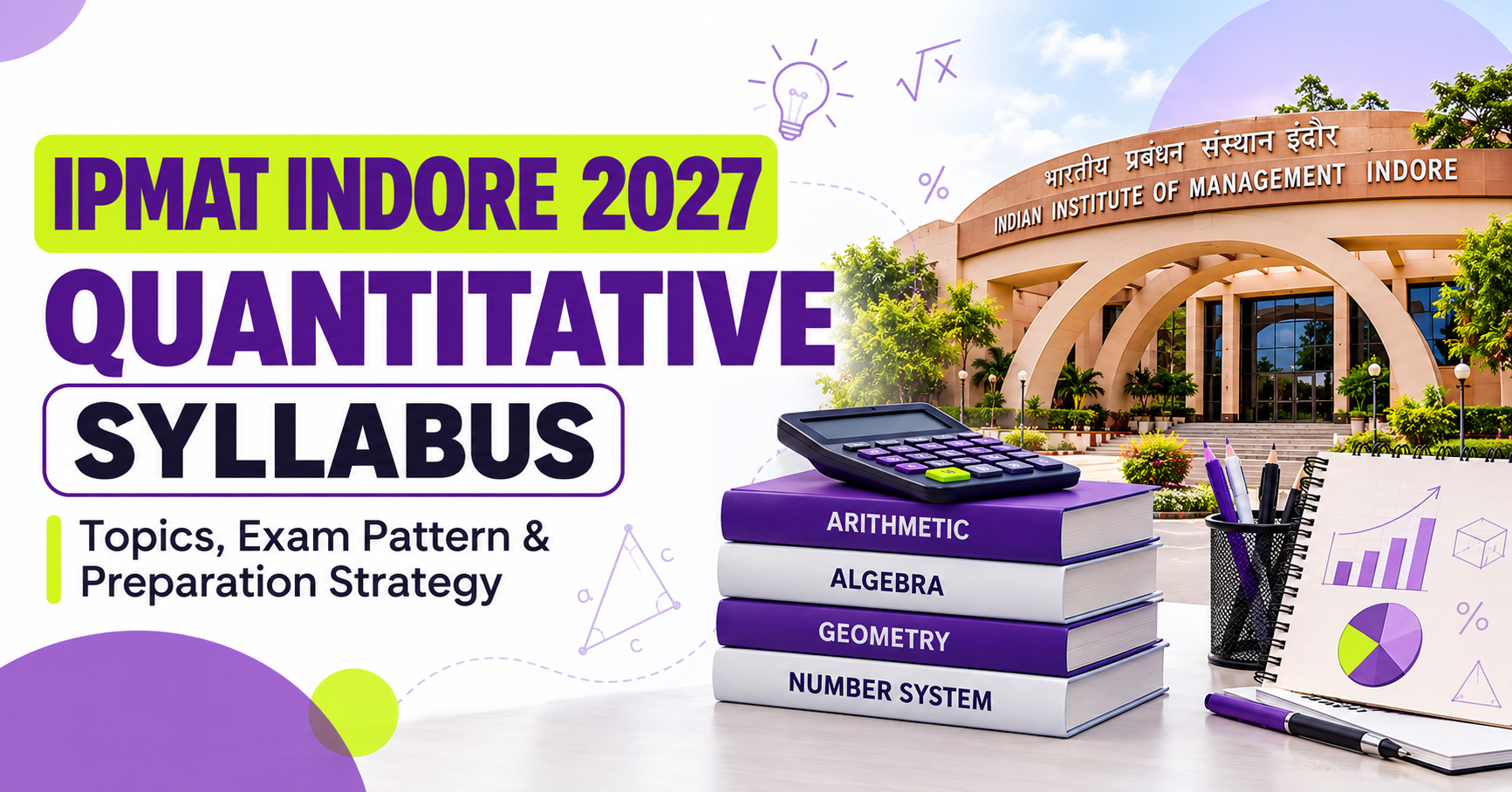
The IPMAT Indore 2027 Quantitative Syllabus is an important part of preparation for students targeting the five-year Integrated Programme in Management (IPM) at IIM Indore. Quantitative Ability tests a student’s understanding of mathematics, problem-solving ability, calculation speed and accuracy.
One important point to remember is that IIM Indore does not publish a fixed chapter-wise Quantitative Ability syllabus. The topics generally considered part of IPMAT preparation are identified from the official exam structure, previous-year papers and recurring question patterns.
For IPMAT Indore 2027, students should therefore prepare a broad range of topics from Arithmetic, Algebra, Number System, Geometry, Modern Mathematics and other quantitative areas.
Quick Answer
The IPMAT Indore 2027 Quantitative Ability syllabus broadly includes:
- Number System
- Percentages
- Ratio and Proportion
- Averages
- Profit, Loss and Discount
- Simple and Compound Interest
- Time, Speed and Distance
- Time and Work
- Algebra
- Linear and Quadratic Equations
- Inequalities
- Logarithms
- Functions
- Sequence and Series
- Geometry
- Mensuration
- Coordinate Geometry
- Sets
- Permutation and Combination
- Probability
- Matrices and Determinants
- Basic Trigonometry
- Data Interpretation and quantitative problem-solving
Students should cover these areas systematically and use IPMAT Indore previous-year papers to understand how these concepts are tested.
IPMAT Indore 2027 Quantitative Ability Exam Pattern
The Quantitative Ability section is an important part of the IPMAT Indore aptitude test.
Based on the latest official exam structure, Quantitative Ability is divided into two parts:
| Section | Questions | Time |
| Quantitative Ability – MCQ | 30 | 40 minutes |
| Quantitative Ability – Short Answer | 15 | 40 minutes |
The complete aptitude test also includes the Verbal Ability section.
Each question carries four marks. The MCQ section has negative marking for incorrect answers, while the Quantitative Ability Short Answer section does not have negative marking.
This makes it important for students to develop both speed and accuracy during preparation.
IPMAT Indore 2027 Quantitative Syllabus: Topic-Wise
1. Number System
Number System is one of the fundamental areas of IPMAT Quant preparation. A strong understanding of numbers can also help with several other topics.
Important topics include:
- Natural and whole numbers
- Integers
- Prime numbers
- Factors and multiples
- HCF and LCM
- Divisibility rules
- Remainders
- Unit digits
- Cyclicity
- Factorials
- Number of factors
- Even and odd numbers
- Surds and indices
Students should practise different types of remainder, divisibility and factorisation problems rather than simply memorising rules.
2. Arithmetic
Arithmetic is one of the most important areas for IPMAT Indore Quantitative Ability preparation.
Students should cover:
- Percentages
- Ratio and Proportion
- Averages
- Profit and Loss
- Discounts
- Simple Interest
- Compound Interest
- Mixtures and Alligation
- Partnership
- Time and Work
- Pipes and Cisterns
- Time, Speed and Distance
- Relative Speed
- Problems on Ages
- Boats and Streams
- Trains
Arithmetic questions often require students to apply more than one concept. For example, a question can combine percentages with profit and loss or ratio with averages.
Therefore, students should gradually move from basic questions to mixed-concept problems.
3. Algebra
Algebra forms another major part of the IPMAT Indore Quantitative Ability syllabus.
Important topics include:
- Algebraic identities
- Linear equations
- Quadratic equations
- Polynomials
- Factorisation
- Inequalities
- Modulus
- Exponents
- Logarithms
- Functions
- Sequences and Series
- Arithmetic Progression
- Geometric Progression
- Binomial Theorem
- Maximum and minimum
Students should focus on understanding the logic behind algebraic concepts instead of relying only on formulas.
4. Geometry and Mensuration
Geometry requires both conceptual clarity and visualisation.
Important topics include:
- Lines and angles
- Triangles
- Similarity and congruence
- Quadrilaterals
- Polygons
- Circles
- Areas and perimeters
- Coordinate Geometry
- Mensuration
- Surface area
- Volume
- Basic Trigonometry
- Heights and distances
Students should learn the important properties and formulas first and then solve application-based questions.
5. Sets and Venn Diagrams
Sets can be useful for solving questions involving groups, categories and overlapping information.
Important topics include:
- Types of sets
- Union
- Intersection
- Difference
- Complement
- Venn diagrams
- Two-set problems
- Three-set problems
Regular practice is important because these questions often depend on correctly interpreting the information given.
6. Permutation and Combination
Permutation and Combination focuses on counting and arrangements.
Students should prepare:
- Fundamental counting principle
- Factorials
- Permutations
- Combinations
- Selection problems
- Arrangement problems
- Circular arrangements
- Problems involving restrictions
The key challenge is usually identifying whether a question requires arrangement or selection.
7. Probability
Probability is closely related to Permutation and Combination.
Important areas include:
- Basic probability
- Events
- Complementary probability
- Independent events
- Conditional probability basics
- Counting-based probability
Students should first build a strong understanding of basic probability before attempting advanced problems.
8. Matrices and Determinants
Matrices and Determinants are additional topics that students should consider during their IPMAT preparation.
Important areas include:
- Types of matrices
- Matrix operations
- Addition and multiplication
- Determinants
- Properties of determinants
- Solving equations using matrices
The level of questions can vary, so students should use previous-year questions and mock tests to understand the expected difficulty.
9. Data Interpretation
Students should also develop the ability to understand and analyse numerical information.
Questions may involve:
- Tables
- Graphs
- Charts
- Caselets
- Data comparison
- Percentage calculations
- Ratio-based calculations
The main objective is not just calculation but the ability to extract relevant information quickly and accurately.
Important Quant Topics for IPMAT Indore 2027
While there is no official chapter-wise weightage released by IIM Indore, students can prioritise their preparation around the following broad areas:
| Area | Topics to Prioritise |
| Arithmetic | Percentage, Ratio, Average, Profit & Loss, TSD, Time & Work |
| Algebra | Equations, Inequalities, Logarithms, Functions, Progressions |
| Number System | Divisibility, Remainders, Factors, HCF & LCM |
| Geometry | Triangles, Circles, Coordinate Geometry, Mensuration |
| Modern Mathematics | Sets, P&C, Probability |
| Higher Mathematics | Matrices, Determinants, Binomial Theorem |
| Data | Tables, Charts and Caselets |
The exact distribution of questions can change from one examination to another. Therefore, students should avoid preparing only a few predicted chapters.
How to Prepare for IPMAT Indore 2027 Quantitative Ability
Start With the Basics
Begin with Number System and Arithmetic. These topics build the foundation required for many other areas.
Move to Algebra and Geometry
Once your basic concepts are clear, start Algebra, Geometry and Mensuration. These topics require consistent practice.
Practise IPMAT-Level Questions
School-level questions alone may not be enough. Start solving aptitude questions that require faster calculations and multiple concepts.
Solve Previous-Year Questions
Previous-year papers help students understand:
- Question types
- Difficulty level
- Calculation requirements
- Time pressure
- Frequently tested concepts
Do not simply check whether an answer is correct. Understand why a particular approach works.
Practise Both QA Sections
The MCQ and Short Answer sections require slightly different approaches.
For MCQs, focus on:
- Speed
- Accuracy
- Smart question selection
- Option elimination
For Short Answer questions, focus on:
- Conceptual clarity
- Direct solving
- Calculation accuracy
- Avoiding careless mistakes
Take Regular Mock Tests
Mock tests should become an important part of preparation as the examination approaches.
After every mock, identify:
- Questions you could not solve
- Questions that took too much time
- Calculation mistakes
- Conceptual mistakes
- Questions that should have been skipped
Mock analysis can help improve performance more effectively than simply taking one test after another.
IPMAT Indore 2027 Quantitative Preparation Plan
First Phase: Concept Building
Complete the basic concepts of:
- Number System
- Arithmetic
- Algebra
- Geometry
Focus on understanding rather than speed.
Second Phase: Topic-Wise Practice
Start solving IPMAT-level questions after completing individual topics.
Maintain an error notebook containing important formulas, shortcuts and repeated mistakes.
Third Phase: Previous-Year Papers
Solve previous-year IPMAT Indore questions under timed conditions.
This helps you understand the actual application of concepts.
Fourth Phase: Mock Tests
Move towards sectional and full-length mocks.
Work on your:
- Attempt strategy
- Time management
- Accuracy
- Question selection
Final Phase: Revision
In the final stage, revise formulas, important concepts, previous mistakes and frequently tested question types.
Avoid starting completely new topics at the last moment unless they are essential.
Common Mistakes Students Make in IPMAT Quant
Ignoring Arithmetic
Some students immediately focus on advanced Mathematics while ignoring Arithmetic. This can create gaps in preparation.
Studying Only From School Textbooks
School Mathematics provides a useful foundation, but IPMAT requires aptitude-oriented practice.
Ignoring Short Answer Questions
Students should specifically practise questions without answer options because the Short Answer section requires independent solving.
Focusing Only on Speed
Speed is important, but inaccurate attempts can hurt your score, especially in the MCQ section.
Not Analysing Mock Tests
Taking a mock without reviewing mistakes limits its usefulness.
Ekoching Expert Insight
For IPMAT Indore 2027, completing the Quantitative Ability syllabus is only the first step.
The real challenge is learning how to identify the right method, solve efficiently and maintain accuracy under time pressure.
Students should follow a preparation cycle of:
Concept → Practice → Previous-Year Questions → Sectional Tests → Mock Tests → Analysis
Starting preparation early also gives Class 11 and Class 12 students enough time to balance IPMAT preparation with school academics.
At Ekoching, students preparing for IPMAT can work on their Quantitative Ability through structured classroom learning, practice, mock tests, doubt solving and regular performance analysis.
If you are preparing for IPMAT from Ahmedabad, starting your Quant preparation early can help you build a stronger foundation before entering the intensive mock-test phase.
IPMAT Indore 2027 Quantitative Syllabus: Key Takeaways
- IIM Indore does not publish a fixed chapter-wise Quantitative Ability syllabus.
- Number System, Arithmetic, Algebra and Geometry should form the core of preparation.
- Students should also prepare Sets, P&C, Probability, Functions, Progressions and other relevant topics.
- QA-MCQ and QA-Short Answer require different preparation approaches.
- Previous-year papers are essential for understanding the examination.
- Mock tests should always be followed by detailed analysis.
- Speed and accuracy are equally important.
- Students should avoid depending entirely on predicted topic weightage.
Frequently Asked Questions
What is the IPMAT Indore 2027 Quantitative syllabus?
The IPMAT Indore 2027 Quantitative syllabus broadly covers Number System, Arithmetic, Algebra, Geometry, Mensuration, Coordinate Geometry, Sets, Probability, Permutation and Combination, Functions, Logarithms, Progressions and other quantitative topics.
Is the IPMAT Indore Quant syllabus officially released chapter-wise?
No. IIM Indore does not provide a fixed chapter-wise Quantitative Ability syllabus. Students generally use the official exam structure, previous-year papers and recurring concepts to plan their preparation.
Which topics are most important for IPMAT Indore Quant?
Arithmetic, Algebra, Number System and Geometry are important areas to prioritise. However, students should prepare the wider syllabus rather than relying only on a few predicted topics.
Is Class 11 and 12 Maths enough for IPMAT?
Class 11 and 12 Mathematics can provide a strong foundation, but IPMAT preparation also requires aptitude-based practice, time management, calculation speed and previous-year question practice.
Does IPMAT Indore have Short Answer questions?
Yes. The Quantitative Ability section includes both Multiple Choice Questions and Short Answer questions under the latest exam structure.
Is there negative marking in IPMAT Indore Quant?
Incorrect answers in the MCQ section carry negative marking. The Quantitative Ability Short Answer section does not have negative marking under the latest official pattern.
How should I prepare for IPMAT Indore Quant?
Start with basic concepts, practise topic-wise questions, solve previous-year papers, take sectional tests and gradually move towards full-length mock tests. Analyse your mistakes after every test.
Start Your IPMAT 2027 Preparation With Ekoching
Preparing for IPMAT requires more than knowing the syllabus. You need the right strategy, regular practice and consistent performance analysis.
If you are targeting IIM Indore IPMAT 2027, explore Ekoching’s IPMAT coaching programme and start building your preparation with expert guidance and structured practice.
Ekoching – Ekoching Hai Toh Ho Jaayega.
