
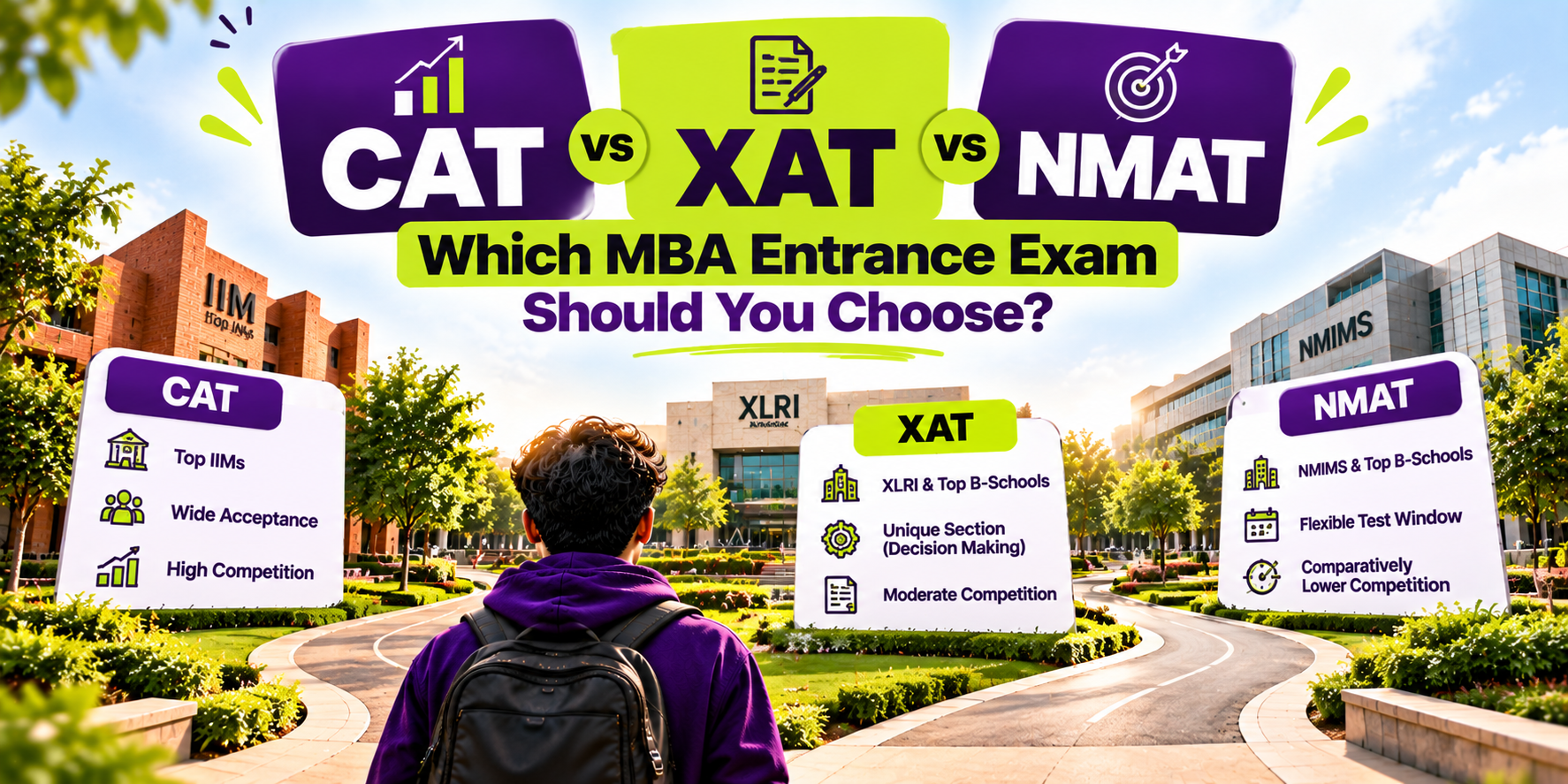
Quick Answer
If your goal is admission to the IIMs and a wide range of leading MBA colleges, CAT should usually be your first priority. If XLRI and other XAT-accepting B-schools are important to you, add XAT to your preparation. NMAT is especially useful for students who want a flexible testing window, no negative marking and the opportunity to take the exam up to three times.
For most MBA aspirants, the smartest approach is not to choose only one exam. CAT preparation creates the core foundation for XAT and NMAT as well. The key is to understand where the three exams differ and then add exam-specific practice at the right stage.
CAT vs XAT vs NMAT at a Glance
| Factor | CAT | XAT | NMAT |
| Main strength | IIMs and broad B-school acceptance | XLRI and 250+ XAT-accepting B-schools | Flexible testing and retakes |
| Core sections | VARC, DILR, QA | VALR, Decision Making, QA & DI, GK | Language, Quantitative, Logical Reasoning |
| Current pattern | 68 questions, 120 minutes in recent pattern | 95 questions, 180 minutes | 108 questions, 120 minutes |
| Negative marking | Applicable to MCQs; no negative for TITA | -0.25 for wrong answers in Part 1 | No negative marking |
| Retakes | One exam attempt per cycle | One exam attempt per cycle | Up to 3 attempts in a testing cycle |
| Best suited for | IIM-focused aspirants | XLRI/XAT-focused aspirants | Students seeking flexibility |
Exam patterns can change, so candidates should always verify the latest official notification before applying. The current XAT 2027 website lists 95 questions, 180 minutes, four sections and an exam date of January 3, 2027. NMAT’s official site lists 108 questions in 120 minutes, no negative marking and up to three attempts. Recent CAT 2026 references continue to show the 68-question, 120-minute, three-section structure.
CAT: Who Should Choose It?
CAT, conducted for admission to the IIMs, is the natural first choice for students who want the widest possible set of MBA opportunities from a single management entrance exam. A strong CAT percentile can open the door to IIMs as well as several other leading business schools that accept CAT scores.
The current CAT pattern used in recent cycles has three sections: Verbal Ability and Reading Comprehension (VARC), Data Interpretation and Logical Reasoning (DILR), and Quantitative Ability (QA). The recent pattern has 68 questions to be attempted in 120 minutes, with 40 minutes allotted to each section.
Why CAT may be the right choice
- You want to target the IIMs or keep your B-school options broad.
- You are comfortable with a high-competition percentile-based exam.
- You can build strong fundamentals in QA, DILR and VARC.
- You are willing to spend several months on concepts, practice and mock-test analysis.
- You want one strong preparation base that can also support XAT and NMAT preparation.
CAT is not only about solving difficult questions. The bigger challenge is selecting the right questions under a strict sectional timer. This makes mock tests, previous year papers, question selection and detailed analysis extremely important.
XAT: Who Should Choose It?
XAT is particularly important for students who have XLRI Jamshedpur or other XAT-accepting B-schools on their target list. The official XAT 2027 website states that the exam is accepted by 250+ B-schools.
The biggest difference between CAT and XAT is the Decision Making section. XAT asks candidates to read situations, identify relevant information, evaluate alternatives and select the most appropriate decision. This requires judgement and reasoning rather than simply applying a formula.
The official XAT 2027 pattern lists 95 questions: 26 in Verbal Ability and Logical Reasoning, 21 in Decision Making, 28 in Quantitative Aptitude and Data Interpretation, and 20 in General Knowledge. The first part is 170 minutes and GK gets 10 minutes.
Why XAT may be the right choice
- XLRI is one of your primary MBA targets.
- You enjoy case-based reasoning and decision-oriented questions.
- You want to expand your B-school options beyond CAT-accepting institutes.
- You are comfortable with a longer paper and XAT’s unique marking rules.
- You are ready to prepare separately for Decision Making and GK.
XAT also requires a different mock strategy. A candidate who performs well in CAT should not assume that the same attempt strategy will automatically work in XAT. Decision Making practice and familiarity with XAT-style questions matter.
NMAT: Who Should Choose It?
NMAT by GMAC is a strong option for candidates who value flexibility. The official NMAT website currently lists a testing window from November 2 to December 20, 2026 for the 2026 cycle. Candidates can schedule a preferred date and time subject to availability.
NMAT has three sections: Language Skills, Quantitative Skills and Logical Reasoning. The official structure has 108 questions and 120 minutes. The exam is computer adaptive, has no negative marking, allows candidates to choose section order and permits up to three attempts in a testing cycle.
Why NMAT may be the right choice
- You want a flexible exam window rather than a single fixed exam date.
- You prefer an exam without negative marking.
- You want the option of retaking the exam to improve your performance.
- You are targeting NMAT-accepting B-schools and have checked their current admission policies.
- You are comfortable working quickly through a computer-adaptive test.
One important point: NMAT registration and B-school applications are separate. Candidates should check each target institute’s current eligibility, application deadline and score-acceptance policy instead of assuming that registration for NMAT automatically completes the college application.
CAT vs XAT vs NMAT: Exam Pattern Difference
1. CAT exam pattern
- VARC: 24 questions in the recent pattern
- DILR: 22 questions in the recent pattern
- QA: 22 questions in the recent pattern
- Total: 68 questions
- Duration: 120 minutes
- Sectional timing: 40 minutes per section
- MCQs generally carry negative marking; TITA questions do not carry negative marking.
2. XAT exam pattern
- VALR: 26 questions
- Decision Making: 21 questions
- QA & DI: 28 questions
- GK: 20 questions
- Total: 95 questions
- Duration: 180 minutes
- Part 1: 170 minutes; GK: 10 minutes
- Part 1 has -0.25 for an incorrect answer and a penalty for excessive unattempted questions; GK has no negative marking.
3. NMAT exam pattern
- Language Skills: 36 questions, 28 minutes
- Quantitative Skills: 36 questions, 52 minutes
- Logical Reasoning: 36 questions, 40 minutes
- Total: 108 questions
- Duration: 120 minutes
- No negative marking
- Computer-adaptive format with flexible section order
Which Exam Is More Difficult: CAT, XAT or NMAT?
There is no universal answer because difficulty depends on your strengths. CAT is highly competitive and demands strong accuracy, question selection and sectional time management. XAT can feel more unpredictable because of Decision Making and its distinctive question style. NMAT may look more manageable because there is no negative marking, but its time pressure and adaptive format make speed and consistency important.
Instead of asking which exam is easiest, ask which exam matches your target colleges and strengths. A student who is strong in reading comprehension and logical reasoning may enjoy XAT. A student who wants IIMs should prioritise CAT. A student who values multiple attempts and a flexible schedule may find NMAT attractive.
CAT vs XAT vs NMAT: Which One Should You Take?
| Your Goal | Recommended Priority |
| IIMs are your main target | CAT first |
| XLRI is a top target | CAT + XAT |
| You want a wider B-school list | CAT + XAT + NMAT |
| You prefer flexible testing and retakes | NMAT |
| You enjoy case-based decision questions | XAT |
| You want one common preparation foundation | Start with CAT, then add XAT/NMAT-specific practice |
Should You Prepare for CAT, XAT and NMAT Together?
For many students, yes. The three exams overlap significantly in Quantitative Aptitude, Logical Reasoning and Verbal Ability. Starting with a CAT-focused foundation can therefore reduce duplicated effort.
- Build common concepts first: arithmetic, algebra, geometry, modern maths, reading comprehension, verbal ability, logical reasoning and data interpretation.
- Start regular sectional practice after your concepts become stable.
- Use CAT mocks and previous year papers to build speed, accuracy and question-selection skills.
- Add XAT Decision Making practice well before the XAT exam.
- Add NMAT-specific timed practice because its adaptive format and no-negative-marking strategy require a different approach.
- After every mock, analyse not only your score but also time spent, accuracy, skipped questions and avoidable mistakes.
This approach is especially useful for students preparing from Ahmedabad and Gujarat because a single structured preparation plan can cover multiple MBA entrance exams while keeping college applications open across different institutes.
How to Prepare for CAT, XAT and NMAT
Build a strong common foundation
Do not jump directly into full-length mocks without understanding the fundamentals. Build concepts first and then move from topic tests to sectional tests and finally full mocks. Your preparation should gradually shift from learning concepts to applying them under time pressure.
Use mocks as an analysis tool
A mock test is useful only when you analyse it properly. Track three things after every test: questions you should have attempted, questions you attempted incorrectly, and questions that consumed too much time. Over time, this gives you a personalised exam strategy.
Practise previous year papers
Previous year papers help you understand the actual language, difficulty and recurring concepts of an exam. For CAT, they are especially valuable for understanding DILR set selection and VARC reading patterns. XAT aspirants should also practise Decision Making questions regularly, while NMAT candidates should focus on timed practice and adaptive-test strategy.
Do not ignore the admission stage
Getting a good score is only one part of the MBA journey. Shortlisting, profile evaluation, interviews, WAT/GD-PI preparation and college selection also matter. A good preparation plan should therefore continue beyond the entrance test.
Ekoching Expert Insight
If you are unsure whether to prepare for CAT, XAT or NMAT, do not make the decision only by comparing difficulty levels. First make a target-college list. Once you know which B-schools you want, work backwards to the exams they accept.
For students in Ahmedabad, Ekoching provides CAT-focused preparation with support for other management entrance exams such as XAT and NMAT. Its current CAT coaching offering includes classroom and online options, personalised mentoring, mock tests, sectional and topic tests, and post-exam GD-PI/WAT guidance. The institute also lists XAT and NMAT coverage within its MBA entrance preparation ecosystem.
Why Ekoching Can Help With MBA Entrance Preparation
- Classroom and online preparation options for students with different schedules.
- Personalised mentoring and smaller learning groups.
- Regular mock tests, sectional tests and topic-wise practice.
- Exam-focused sessions to understand changing question trends.
- Doubt-solving support and structured performance analysis.
- Post-exam support including GD-PI, WAT and profile guidance.
- MBA entrance preparation that can cover CAT along with XAT, NMAT and other management exams.
The advantage of an integrated approach is simple: instead of preparing separately for every exam from day one, students can first strengthen the common syllabus and then add exam-specific modules. This can make preparation more efficient and reduce unnecessary repetition.
Key Takeaways
- Choose CAT if IIMs and broad MBA options are your main priority.
- Choose XAT if XLRI and XAT-accepting B-schools are important targets.
- Choose NMAT if flexibility, multiple attempts and no negative marking are major advantages for you.
- CAT preparation provides a strong base for XAT and NMAT because of the overlap in core aptitude areas.
- Do not rely only on overall mock scores; analyse accuracy, time management and question selection.
- Always check the latest official exam notification and individual B-school admission policy before applying.
Frequently Asked Questions
Is CAT better than XAT and NMAT?
CAT is not automatically better; it depends on your target colleges. CAT is the key exam for IIM admissions, while XAT and NMAT provide access to their respective accepting institutes. Many serious MBA aspirants prepare for more than one exam.
Can I prepare for CAT, XAT and NMAT together?
Yes. The core syllabus overlaps significantly. Start with common aptitude preparation and then add XAT Decision Making and NMAT-specific timed practice.
Which is easier, CAT or XAT?
Difficulty is subjective. CAT is highly competitive and time-bound, while XAT has a distinctive Decision Making section and different marking rules. Your strengths matter more than a simple easier-versus-harder label.
Is NMAT easier than CAT?
NMAT has no negative marking and allows multiple attempts, but its computer-adaptive format and tight sectional timings demand speed and consistency. It should not be treated as an automatically easy exam.
How many times can I take NMAT?
The official NMAT policy currently permits a maximum of three attempts in a testing cycle, including the first attempt and up to two retakes.
Does XAT have negative marking?
Yes. In the current XAT pattern, Part 1 has a 0.25-mark penalty for an incorrect answer and a 0.10-mark penalty for each unattempted question after the first eight. GK has no negative marking.
Which exam should I take if I want XLRI?
XAT should be a major priority because XLRI’s flagship management programmes use XAT as an entrance route. Always check the current programme-specific admission requirements.
Can CAT preparation help with NMAT?
Yes. QA, logical reasoning and verbal preparation overlap substantially. However, NMAT requires additional practice for its speed, adaptive format and section timing.
Should working professionals prepare for all three exams?
It can be a good strategy if the target colleges justify it. Working professionals should prioritise a manageable study schedule, common concepts first and targeted exam-specific practice later.
