
Quick Answer
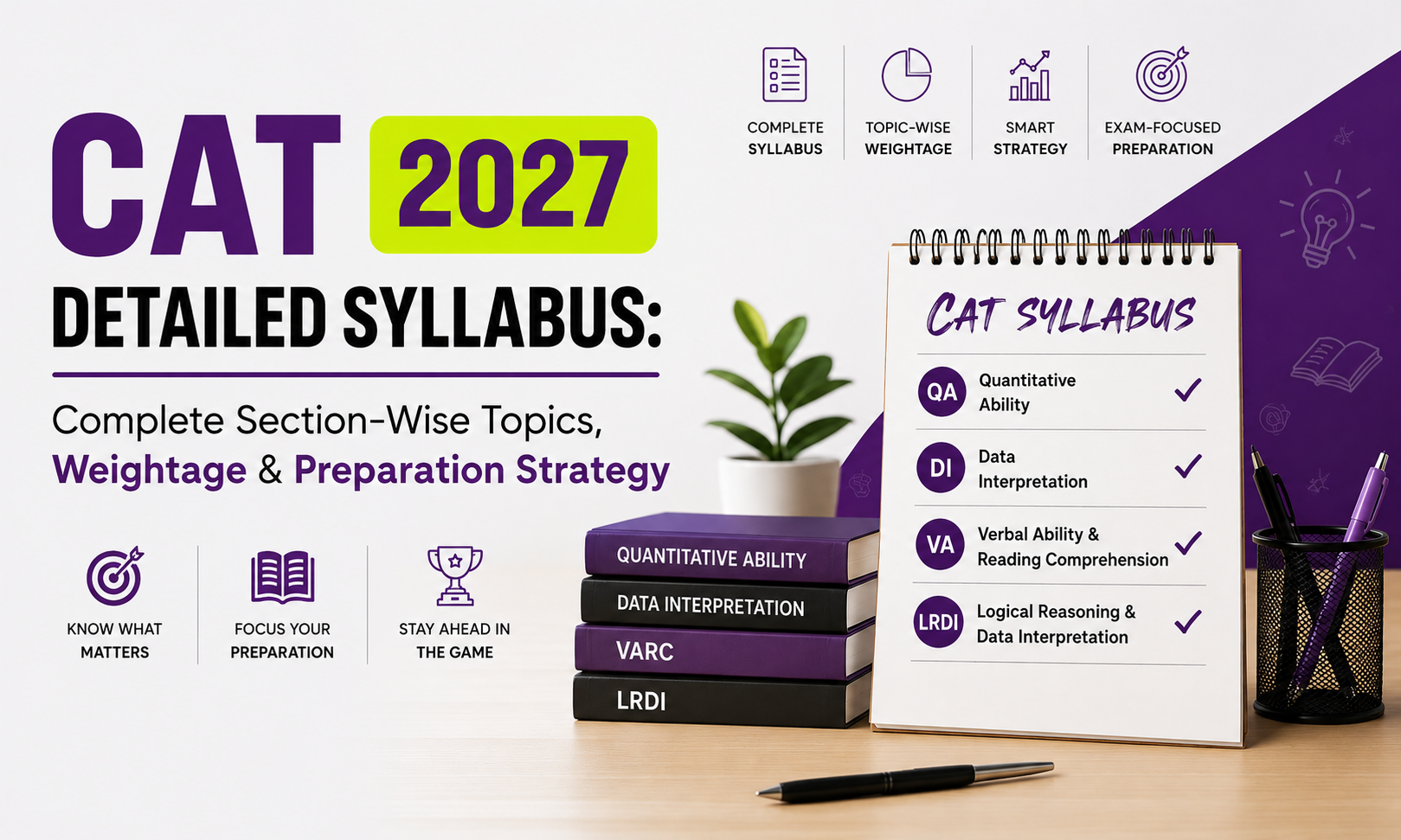
The CAT 2027 syllabus consists of three sections: Verbal Ability & Reading Comprehension (VARC), Data Interpretation & Logical Reasoning (DILR), and Quantitative Aptitude (QA). The syllabus is not officially released by IIMs, but previous year CAT papers consistently show that these three areas form the entire CAT exam.
Introduction
If you are planning to prepare for CAT 2027, the first and most important step is understanding the complete CAT syllabus. Every year thousands of MBA aspirants begin preparation without knowing which topics are actually tested, which often leads to wasted time and poor score improvement. The good news is that although IIMs do not officially release a fixed syllabus, the pattern of questions asked over the last several years provides a very reliable framework for preparation. This guide explains the complete CAT 2027 syllabus in detail, including section-wise topics, expected weightage, preparation priority, and a practical study strategy.
CAT 2027 Exam Pattern Overview
| Section | Expected Questions | Time |
| VARC | 24 | 40 minutes |
| DILR | 22 | 40 minutes |
| QA | 22 | 40 minutes |
| Total | 68 | 120 minutes |
Key Features:
– Computer-Based Test (CBT)
– English medium only
– MCQs and TITA (Type In The Answer) questions
– +3 for every correct answer
– -1 for incorrect MCQs
– No negative marking for TITA questions
– No switching between sections during the exam
Is There an Official CAT 2027 Syllabus?
No. The Indian Institutes of Management (IIMs) do not publish a fixed detailed syllabus for CAT. The syllabus discussed in this article is based on previous year CAT papers and the topic trends that have appeared consistently in recent exams.
CAT 2027 Syllabus: Verbal Ability & Reading Comprehension (VARC)
VARC is usually the first section in the CAT exam and often carries the highest number of questions. It evaluates reading ability, comprehension, vocabulary in context, logical flow of ideas, and critical reasoning.
Reading Comprehension Topics
– Philosophy
– Economics
– Psychology
– Sociology
– History
– Politics
– Business & Management
– Science & Technology
– Environment
– Literature
– Culture & Arts
Common question types include main idea, inference, author’s tone, assumptions, paragraph function, fact vs opinion, and title selection.
Verbal Ability Topics
– Para Jumbles
– Para Summary
– Odd One Out
– Sentence Completion
– Contextual Grammar and Usage
High-Weightage VARC Topics
| Topic | Priority |
| Reading Comprehension | Very High |
| Para Summary | High |
| Para Jumbles | High |
| Odd One Out | Medium-High |
| Vocabulary in Context | Medium |
Best Strategy for VARC
Read editorials daily, solve 3–4 RC passages every day, analyse wrong answers carefully, and focus on understanding the author’s argument rather than memorising vocabulary lists.
CAT 2027 Syllabus: Data Interpretation & Logical Reasoning (DILR)
DILR is often considered the most unpredictable section of CAT because of the variety of puzzles and data sets.
Data Interpretation Topics
– Tables
– Bar Graphs
– Line Graphs
– Pie Charts
– Caselets
– Mixed Graphs
– Table with Missing Values
– Special Charts
Logical Reasoning Topics
– Seating Arrangements (Linear, Circular, Rectangular)
– Puzzles (Floor, Box, Scheduling, Assignment)
– Venn Diagrams
– Games & Tournaments
– Binary Logic
– Networks & Routes
– Team Selection
– Data Arrangement
– Ordering & Ranking
High-Weightage DILR Topics
| Topic | Priority |
| Tables & Charts | Very High |
| Seating Arrangements | Very High |
| Puzzles | High |
| Games & Tournaments | High |
| Venn Diagrams | Medium |
| Binary Logic | Medium |
Best Strategy for DILR
Solve at least 2–3 complete sets daily, practise under time limits, learn to leave difficult sets quickly, and use diagrams, tables, and grids to organise information.
CAT 2027 Syllabus: Quantitative Aptitude (QA)
QA is largely based on Class 9 and 10 Mathematics concepts, but the questions are application-oriented and require strong analytical thinking.
Arithmetic
– Percentages
– Profit, Loss & Discount
– Ratio & Proportion
– Averages
– Time, Speed & Distance
– Time & Work
– Simple & Compound Interest
– Mixtures & Alligation
Algebra
– Linear Equations
– Quadratic Equations
– Inequalities
– Functions
– Logarithms
– Progressions (AP & GP)
– Surds & Indices
– Modulus
Geometry
– Triangles
– Circles
– Quadrilaterals
– Polygons
– Coordinate Geometry
– Angles and Properties
Mensuration
– 2D Mensuration (Area & Perimeter)
– 3D Mensuration (Volume & Surface Area)
Number System
– Divisibility Rules
– HCF & LCM
– Remainders
– Factors & Multiples
– Base Systems
– Cyclicity
Modern Mathematics
– Permutation & Combination
– Probability
– Set Theory
– Mean, Median & Mode
– Basic Counting Principles
High-Weightage QA Topics
| Topic | Priority |
| Arithmetic | Very High |
| Algebra | Very High |
| Geometry | High |
| Number System | High |
| Mensuration | Medium |
| Probability & P&C | Medium |
Topic-Wise CAT 2027 Preparation Priority
| Topic | Importance |
| Reading Comprehension | Very High |
| Arithmetic | Very High |
| Algebra | Very High |
| Tables & Charts | Very High |
| Seating Arrangement | Very High |
| Puzzles | High |
| Geometry | High |
| Number System | High |
| Probability | Medium |
How to Cover the CAT 2027 Syllabus in 12 Months
Phase 1: Build Fundamentals (Months 1–3)
– Arithmetic
– Basic Algebra
– Reading habits
– Basic DI sets
Phase 2: Expand Coverage (Months 4–6)
– Geometry
– Number System
– Advanced RC
– LR puzzles
Phase 3: Intensive Practice (Months 7–9)
– Mixed QA questions
– DILR set selection
– VARC sectional tests
Phase 4: Mock Test Phase (Months 10–12)
– Full-length CAT mocks
– Detailed analysis
– Weak-area improvement
– Time management optimisation
Recommended Books for CAT 2027
VARC: Arun Sharma & Meenakshi Upadhyay, Norman Lewis – Word Power Made Easy
DILR: Arun Sharma – Logical Reasoning and Data Interpretation, Previous Year CAT Papers
QA: Arun Sharma – Quantitative Aptitude, Sarvesh Verma – Quantum CAT
Common Mistakes Students Make
– Ignoring Reading Comprehension
– Spending too much time on one DILR set
– Memorising formulas without application
– Avoiding mock tests
– Not analysing previous year papers
– Neglecting sectional time management
Ekoching Expert Insight
At Ekoching Institute Ahmedabad, we have observed that students who complete Arithmetic, Algebra, and RC fundamentals within the first three months generally perform much better in mock tests. CAT is not a syllabus-heavy exam; it is a skill-based exam where consistency, mock analysis, and strategic practice matter more than repeatedly reading theory.
Key Takeaways
– CAT 2027 has three sections: VARC, DILR, and QA.
– The exam is expected to have 68 questions in 120 minutes.
– Reading Comprehension, Arithmetic, and Algebra are the most important topics.
– DILR requires smart set selection and analytical thinking.
– A structured 10–12 month preparation plan is ideal.
– Regular mock tests and previous year paper analysis are essential for a high percentile.
Frequently Asked Questions (FAQs)
Is the CAT 2027 syllabus officially released by IIM?
No. The syllabus is derived from previous year CAT papers and recurring topic trends.
Which section has the highest weightage in CAT 2027?
VARC generally has the highest number of questions, with Reading Comprehension contributing the majority of them.
Is CAT Quant based on Class 11 and 12 Maths?
Mostly no. CAT Quant is primarily based on Class 9 and 10 Mathematics concepts, but the questions are application-oriented.
Is DILR difficult in CAT?
Yes. DILR is often considered the most challenging section because of unpredictable puzzle and data interpretation sets.
Can I prepare for CAT 2027 in one year?
Yes. A focused 10–12 month preparation plan with regular mocks and sectional tests is sufficient for most serious aspirants.
Which topics should I start first for CAT 2027?
Start with Arithmetic, Algebra, Reading Comprehension, and basic DILR sets.
