
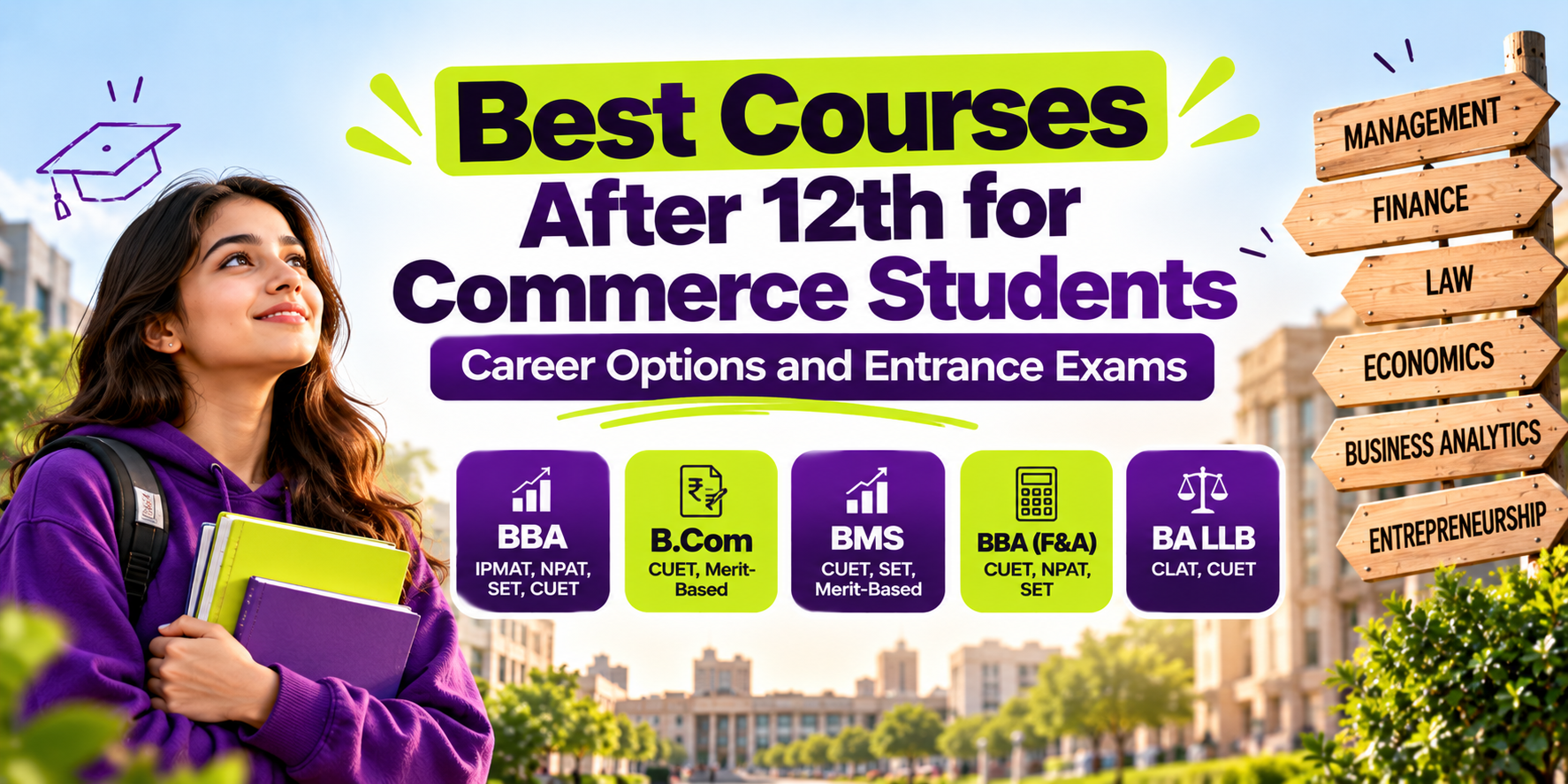
Completing Class 12 with Commerce opens the door to a wide range of academic and career opportunities. While B.Com has traditionally been one of the most common choices, Commerce students today can explore management, finance, economics, law, technology, entrepreneurship, banking and several professional courses.
The right course after 12th Commerce depends on a student’s interests, strengths, career goals and preferred work area. Some students may prefer accounting and finance, while others may be interested in business management, law, economics or technology.
This guide explains the best courses after 12th Commerce, career opportunities associated with them, important entrance exams and factors students should consider before selecting a course.
Best Courses After 12th Commerce
Commerce students have several undergraduate and professional options after Class 12. Some of the most popular choices include:
- B.Com and B.Com (Hons.)
- BBA (Bachelor of Business Administration)
- BMS (Bachelor of Management Studies)
- Economics
- Chartered Accountancy (CA)
- Company Secretary (CS)
- Cost and Management Accountancy (CMA)
- Integrated Management Programmes(iMBA)
- BA LLB and BBA LLB
- BCA
- Banking and Finance
- Hotel Management
- Other specialised undergraduate programmes
Let’s understand these options and the career opportunities they can offer.
1. B.Com and B.Com (Hons.)
Bachelor of Commerce is one of the most established choices after 12th Commerce. The course provides students with a foundation in accounting, finance, economics, taxation, business law and related areas.
B.Com (Hons.) generally offers more specialised and detailed study in commerce-related subjects.
Career Options After B.Com
- Accountant
- Financial Analyst
- Tax Consultant
- Auditor
- Banking Professional
- Business Analyst
- Finance Executive
- Investment-related roles
B.Com can also be followed by professional qualifications such as CA, CMA, CS or higher education such as an MBA or M.Com.
Admission and Entrance Exams for B.Com
Admission requirements vary between universities. Some institutions offer merit-based admission, while others use entrance examinations.
CUET-UG is one of the important entrance routes for undergraduate admissions at participating universities.
2. BBA – Bachelor of Business Administration
BBA is an undergraduate programme focused on business and management. It can be a suitable option for students who are interested in how businesses operate and want to develop knowledge in areas such as marketing, finance, human resources, operations and entrepreneurship.
BBA programmes may cover subjects such as:
- Principles of Management
- Marketing
- Finance
- Human Resource Management
- Business Communication
- Entrepreneurship
- Operations Management
- Business Analytics
Career Options After BBA
- Marketing
- Sales
- Business Development
- Human Resources
- Finance
- Operations
- Business Analytics
- Consulting
- Entrepreneurship
Students can also pursue an MBA or other postgraduate management programmes after completing BBA.
Entrance Exams for BBA
Depending on the institution, students may need to appear for entrance examinations such as:
- CUET-UG
- NPAT
- SET
- University-specific entrance examinations
Students should check the admission requirements of their preferred college before selecting an entrance exam.
3. BMS – Bachelor of Management Studies
Bachelor of Management Studies is another undergraduate option for students interested in management and business.
BMS programmes generally focus on areas such as:
- Management
- Marketing
- Finance
- Human Resources
- Business Communication
- Operations
- Business Strategy
Career Options After BMS
Graduates can explore careers in management, marketing, sales, finance, operations, consulting and business development.
BMS can also provide a foundation for students who plan to pursue an MBA or other specialised management education.
4. Economics
Economics is a suitable option for students interested in markets, business, data, financial systems and economic trends.
Depending on the university, students can pursue undergraduate programmes such as BA Economics or other specialised Economics programmes.
Career Options After Economics
- Economic Research
- Financial Analysis
- Business Analysis
- Data Analysis
- Market Research
- Consulting
- Research and Policy-related roles
Students can also pursue higher education in economics, finance, business analytics, public policy or management.
5. Chartered Accountancy (CA)
Chartered Accountancy is a professional career path that is particularly relevant for students interested in accounting, auditing, taxation and finance.
CA education covers areas such as:
- Accounting
- Auditing
- Taxation
- Financial Reporting
- Business Laws
- Financial Management
Career Options After CA
- Audit
- Taxation
- Corporate Finance
- Financial Consulting
- Risk Management
- Accounting
- Advisory Services
Students interested in numbers, accounting and financial systems can consider CA as a long-term professional option.
6. Company Secretary (CS)
The Company Secretary course focuses on corporate law, compliance, governance and regulatory requirements.
It can be considered by students who are interested in the legal and regulatory side of businesses.
Career Options After CS
- Corporate Compliance
- Corporate Governance
- Regulatory Affairs
- Secretarial Practice
- Legal Compliance
- Corporate Advisory
The Company Secretary qualification is administered by the Institute of Company Secretaries of India.
7. Cost and Management Accountancy (CMA)
CMA is another professional qualification for students interested in accounting, cost management and financial decision-making.
The course covers areas such as:
- Cost Accounting
- Financial Management
- Strategic Management
- Taxation
- Financial Analysis
Career Options After CMA
- Cost Management
- Management Accounting
- Financial Planning
- Corporate Finance
- Budgeting
- Financial Analysis
8. Integrated Management Programmes
Integrated Management Programmes allow students to begin management education directly after Class 12 through an integrated undergraduate and postgraduate management pathway.
These programmes can be considered by students who are already interested in pursuing a career in business and management.
Depending on the institute, admission may involve an entrance examination and further selection stages.
Integrated management programmes are particularly relevant for students who want to start management education immediately after Class 12 instead of completing a separate bachelor’s degree before pursuing an MBA.
9. Law – BA LLB and BBA LLB
Commerce students can also pursue law after Class 12.
Integrated programmes such as BA LLB and BBA LLB combine undergraduate education with legal studies.
BBA LLB can be particularly relevant for students interested in the combination of business and law.
Career Options After Law
- Corporate Lawyer
- Legal Advisor
- Litigation Lawyer
- Compliance Professional
- Legal Consultant
- In-house Legal Professional
CLAT is one of the major entrance examinations for undergraduate law admissions at participating National Law Universities.
10. BCA – Bachelor of Computer Applications
Commerce students interested in technology can consider BCA, subject to the eligibility requirements of their preferred university.
BCA generally covers areas such as:
- Programming
- Database Management
- Web Development
- Computer Applications
- Software Development
- Information Technology
Career Options After BCA
Students can explore careers in software, IT support, web development, application development, data-related fields and other technology roles.
Eligibility requirements for BCA can vary, particularly regarding Mathematics or other subjects, so students should check the specific university criteria.
11. Banking and Finance
Students interested in banking, financial markets, investment and financial services can explore specialised undergraduate programmes related to banking and finance.
Depending on the programme, students may study:
- Banking
- Financial Markets
- Investment
- Insurance
- Accounting
- Financial Services
Career Options in Banking and Finance
- Banking
- Financial Services
- Investment Operations
- Insurance
- Financial Analysis
- Customer Relationship Management
12. Hotel Management
Students interested in hospitality, tourism, travel and customer service can consider Hotel Management and related undergraduate programmes.
Career Options After Hotel Management
- Hotel Operations
- Food and Beverage Management
- Event Management
- Guest Relations
- Hospitality Management
- Travel and Tourism
Popular Entrance Exams After 12th Commerce
The entrance examination a student needs to take depends on the course and college they want to pursue.
Some important entrance examinations for Commerce students include:
CUET-UG
CUET-UG provides an entrance route for undergraduate admissions at participating universities. Commerce students may explore programmes such as B.Com, BBA, Economics and other undergraduate courses, depending on the university and programme eligibility.
IPMAT
IPMAT is an entrance examination associated with admission to certain Integrated Programme in Management programmes. It is particularly relevant for students interested in pursuing management education directly after Class 12.
NPAT
NPAT is associated with undergraduate admissions at participating NMIMS programmes. Students interested in management and related undergraduate programmes can explore the applicable NPAT admission route.
SET
SET is associated with undergraduate admissions at participating Symbiosis institutes. Students interested in management and other undergraduate programmes can check the applicable programme-wise requirements.
CLAT
CLAT is a major entrance examination for undergraduate law admissions at participating National Law Universities. Students interested in integrated law programmes can consider CLAT as part of their admission planning.
How to Choose the Right Course After 12th Commerce
There is no single course that is suitable for every Commerce student. Students should consider their interests, academic strengths and long-term career plans.
If You Like Accounting and Finance
- B.Com
- B.Com (Hons.)
- CA
- CMA
- Banking and Finance
If You Like Business and Management
- BBA
- BMS
- Integrated Management Programmes
- Economics
If You Are Interested in Law
- BA LLB
- BBA LLB
- Other integrated law programmes
If You Are Interested in Technology
- BCA
- Technology-focused undergraduate programmes
If You Are Interested in Entrepreneurship
- BBA
- BMS
- Integrated Management Programmes
- Economics
What Should Commerce Students Consider Before Choosing a Course?
Before finalising a course, students should look beyond the name of the programme.
Your Interests
Think about the subjects and activities you genuinely enjoy. A student interested in finance may have a different ideal pathway from someone interested in business, law or technology.
Course Curriculum
Understand what subjects you will study during the programme. This helps you determine whether the course matches your interests.
Career Opportunities
Research the types of careers graduates typically pursue after completing the course.
Entrance Exam Requirements
Some universities admit students through entrance examinations, while others may use Class 12 marks or a combination of criteria.
Eligibility
Check the latest eligibility requirements before applying. Some programmes may have specific subject requirements.
Higher Education Options
Consider what you may want to study after graduation. For example, a student may plan to pursue an MBA after BBA or BMS, while another may pursue CA or other professional qualifications alongside or after graduation.
When Should Students Start Preparing for Entrance Exams?
Students targeting competitive entrance examinations should ideally understand the exam pattern and syllabus well before the application and examination period.
Early preparation can provide time to:
- Build fundamentals
- Improve speed and accuracy
- Practise different question types
- Develop reading habits
- Take mock tests
- Identify and improve weak areas
Students should balance entrance preparation with their Class 11 and Class 12 academic studies.
Why IPMAT Can Be an Option for Commerce Students
For Commerce students who are particularly interested in business and management, Integrated Management Programmes can be an option worth exploring after Class 12.
IPMAT is associated with admission to certain Integrated Programme in Management programmes. These programmes provide students with a management-focused academic pathway starting after Class 12.
Students preparing for IPMAT may need to develop skills in areas such as:
- Quantitative Ability
- Verbal Ability
- Reading Comprehension
- Logical Reasoning, depending on the examination
Commerce students should not assume that their Class 12 syllabus alone will be sufficient for IPMAT. Entrance preparation generally requires additional aptitude practice, speed development, reading practice and mock-test analysis.
The exact eligibility criteria, examination pattern and selection process depend on the institute and admission year. Students should always refer to the latest official admission information of their target institute.
IPMAT Preparation for Commerce Students
Students preparing for IPMAT can start by strengthening their fundamentals and gradually moving towards exam-level practice.
Build Quantitative Fundamentals
Work on core concepts and gradually improve speed and accuracy through regular practice.
Develop Reading and Verbal Skills
Reading newspapers, articles, books and other quality content can help students improve comprehension and vocabulary.
Practise Regularly
Consistent practice is important for aptitude-based entrance examinations. Topic-wise questions can be followed by sectional tests and full-length mocks.
Analyse Mock Tests
Taking a mock test is only one part of preparation. Students should also analyse incorrect answers, skipped questions and time-management issues.
Work on Time Management
Entrance examinations are time-bound. Students need to learn how to balance accuracy with speed.
Prepare for IPMAT and BBA Entrance Exams with Ekoching
For students who have decided to pursue management after Class 12, entrance exam preparation can play an important role in the admission journey.
Ekoching provides coaching for IPMAT and BBA entrance examinations, helping students prepare for the aptitude and language skills required for competitive management admissions.
The preparation approach includes structured learning, regular practice, mock tests, doubt solving and mentoring. Students can work on areas such as quantitative aptitude, verbal ability, reading comprehension and logical reasoning based on the requirements of their target examinations.
For students from Commerce backgrounds, the preparation can help bridge the gap between the Class 12 curriculum and the aptitude-based requirements of management entrance examinations.
Students interested in pursuing management after Class 12 can explore Ekoching’s IPMAT and BBA entrance preparation programmes and choose a preparation path based on their target examinations.
Frequently Asked Questions About Courses After 12th Commerce
Which are the best courses after 12th Commerce?
Popular options include B.Com, BBA, BMS, Economics, Integrated Management Programmes, CA, CS, CMA, Law, BCA, Banking and Finance and Hotel Management.
Which course is best for Commerce students interested in business?
Students interested in business can explore BBA, BMS, Integrated Management Programmes and Economics. The right choice depends on the student’s interests and long-term career plans.
Can Commerce students prepare for IPMAT?
Yes. Commerce students can prepare for IPMAT if they meet the eligibility requirements of the specific programme. Preparation generally requires additional aptitude and verbal practice beyond the regular Class 12 syllabus.
What are the main BBA entrance exams after 12th?
Depending on the college, students may encounter entrance exams such as NPAT, SET, CUET-UG and other university-specific examinations. IPMAT is relevant for certain Integrated Management Programmes.
Can students prepare for IPMAT and other BBA entrance exams together?
Students can prepare for multiple management entrance examinations together when their syllabi and skill requirements overlap. However, they should also study the specific pattern and requirements of each target examination.
Can Commerce students without Mathematics pursue management courses?
Many management programmes are available to students without Mathematics, but eligibility requirements vary by institution and programme. Students should check the latest eligibility criteria before applying.
Is BBA better than B.Com after 12th Commerce?
BBA and B.Com have different academic focuses. BBA is more directly focused on business and management, while B.Com provides a broader foundation in commerce, accounting and finance. Students should choose based on their interests and career goals.
When should students start IPMAT preparation?
Students can begin building their foundation early, particularly in quantitative aptitude, reading comprehension, vocabulary and logical reasoning. A structured preparation plan can then be developed closer to the examination.
Conclusion
Commerce students have a wide range of options after Class 12, from B.Com, BBA and BMS to Economics, CA, CS, CMA, Law, BCA, Banking and Finance and other specialised programmes.
The best choice depends on a student’s interests, strengths and career goals. Students interested in accounting may consider B.Com or professional qualifications, while those interested in business and management can explore BBA, BMS and Integrated Management Programmes.
For students who want to pursue management directly after Class 12, entrance examinations such as IPMAT, NPAT, SET and CUET-UG can be important pathways depending on their target institutions.
Understanding the available courses and entrance examinations early allows students to make a more informed decision and start preparing for the requirements of their chosen path.
For students specifically targeting IPMAT and BBA entrance examinations, structured preparation, regular practice and consistent mock-test analysis can help them build the skills required for competitive management admissions.
