
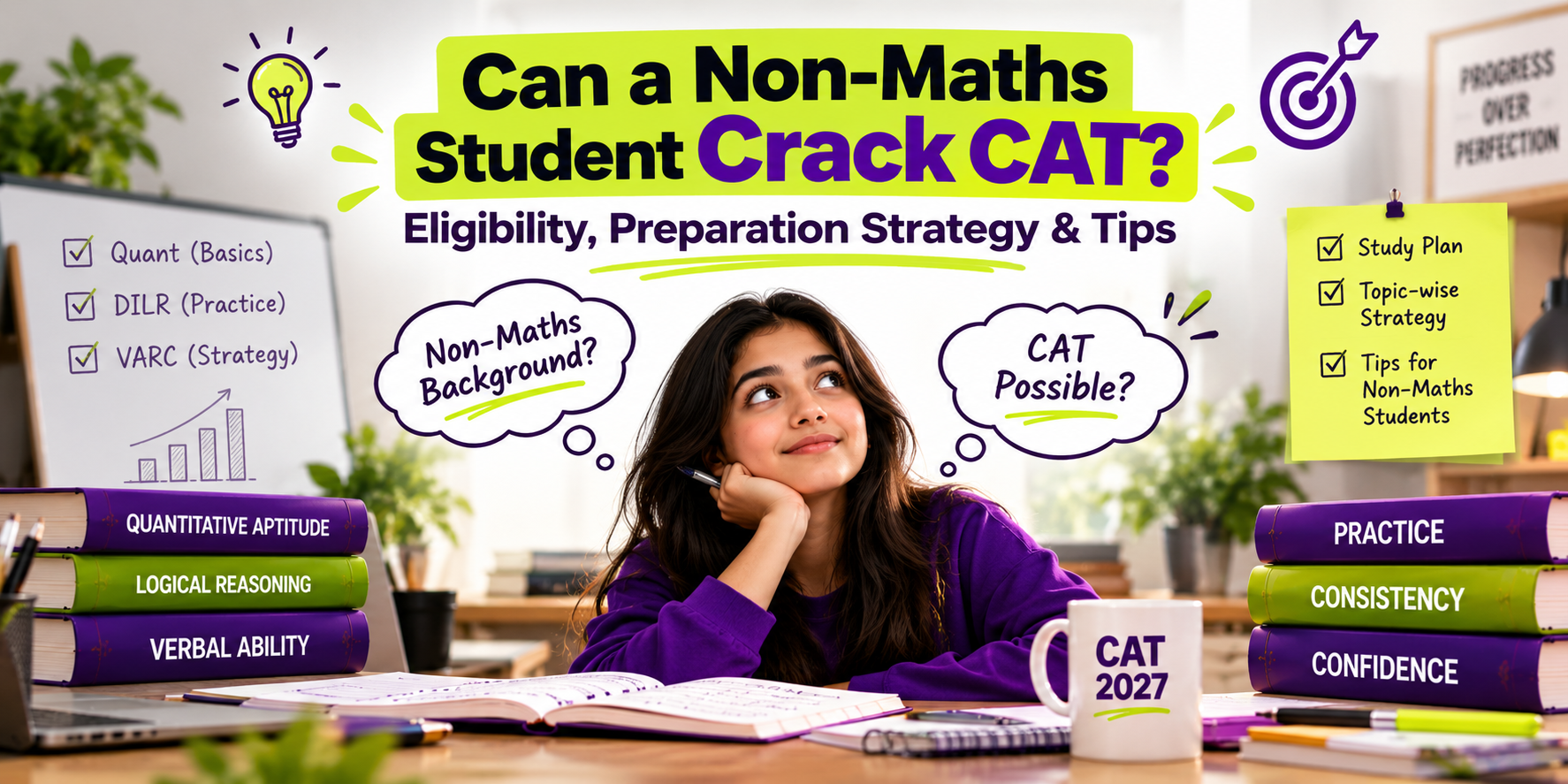
The Common Admission Test (CAT) is often associated with mathematics, numbers, and quantitative aptitude. This can make students from non-maths backgrounds wonder: Can a non-maths student crack CAT?
The answer is yes. CAT does not require you to have studied Mathematics in Classes 11 and 12 to appear for the examination. However, the Quantitative Aptitude (QA) section does require candidates to solve questions based on concepts such as arithmetic, algebra, geometry, number systems, and other mathematical topics.
For a non-maths student, the challenge is usually not the absence of advanced mathematics but the need to build mathematical fundamentals, improve calculation skills, and practise consistently.
With the right preparation strategy, study plan, and regular mock-test practice, students from commerce, humanities, arts, management, and other non-maths backgrounds can prepare effectively for CAT.
Can a Non-Maths Student Crack CAT?
Yes, a non-maths student can crack CAT and compete for admission to leading MBA programmes in India.
CAT tests candidates across three major areas:
• VARC – Verbal Ability and Reading Comprehension
• DILR – Data Interpretation and Logical Reasoning
• QA – Quantitative Aptitude
Only one of these three sections is directly focused on mathematics. VARC primarily tests reading comprehension and verbal ability, while DILR involves interpreting data and solving logical reasoning problems.
Therefore, not having a mathematics background does not automatically put a candidate at a disadvantage across the entire CAT examination.
The key is to identify your weaker areas early and devote additional preparation time to them.
Is Maths Compulsory for CAT?
Mathematics is not compulsory as a subject in Classes 11 and 12 for appearing in CAT.
However, Quantitative Aptitude is a compulsory section of the CAT examination. This means that even students who did not study Mathematics after Class 10 need to prepare mathematical concepts for CAT.
The good news is that CAT QA is largely based on fundamental mathematical concepts rather than highly advanced mathematics.
Important Quantitative Aptitude Topics for Non-Maths Students
Arithmetic
- Percentages
- Profit and Loss
- Simple and Compound Interest
- Ratio and Proportion
- Averages
- Time, Speed and Distance
- Time and Work
- Mixtures and Alligation
Algebra
- Linear equations
- Quadratic equations
- Inequalities
- Functions
- Algebraic expressions
- Progressions
- Basic concepts of higher algebra
Geometry and Mensuration
- Lines and angles
- Triangles
- Circles
- Quadrilaterals
- Polygons
- Coordinate geometry
- Areas and volumes
Number System
- Divisibility
- Factors and multiples
- HCF and LCM
- Remainders
- Units digits
- Number properties
Why Do Non-Maths Students Find CAT Quant Difficult?
Students without a recent mathematics background may initially face difficulty with CAT QA because they may not remember basic formulas or mathematical concepts.
Some common challenges are:
Lack of Mathematical Fundamentals
A student who has not studied mathematics for several years may need to start with basic concepts such as percentages, ratios, equations, and averages.
Slow Calculations
CAT preparation requires efficient calculations. Students who are not used to working with numbers may initially take longer to solve even simple questions.
Fear of Mathematics
Sometimes the biggest barrier is not the difficulty of the question but the fear of attempting it. A student may assume that CAT Quant is too difficult before actually understanding the concepts.
Difficulty Identifying the Right Approach
CAT questions can often be solved using different methods. Non-maths students may initially struggle to identify the shortest or most efficient approach.
Lack of Consistent Practice
Understanding a concept once is not enough. QA requires repeated practice so that concepts become easier to recall during the examination.
How Should a Non-Maths Student Start CAT Preparation?
The best approach is to start with fundamentals instead of immediately solving difficult CAT questions.
A non-maths student can follow this progression:
Concept Building → Basic Questions → CAT-Level Questions → Sectional Tests → Mock Tests → Analysis
Step 1: Start With Basic Mathematics
Begin with topics that form the foundation of CAT QA. A useful sequence is: Percentages, Ratios and Proportions, Averages, Profit and Loss, Simple and Compound Interest, Time, Speed and Distance, Time and Work, Linear Equations, Quadratic Equations, Number System, Geometry, and Modern Mathematics and other advanced topics.
Step 2: Focus on Conceptual Understanding
Do not try to memorise formulas without understanding them. For every topic, understand what the concept means, which formulas are important, when to use each formula, how CAT frames questions around the concept, and which shortcuts can save time.
Step 3: Practise Easy Questions First
Starting directly with difficult CAT questions can be discouraging. Instead, solve questions in increasing difficulty: Basic → Moderate → CAT Level → Difficult.
Step 4: Develop Calculation Skills
Practise percentage calculations, fractions, squares and cubes, approximation, multiplication and division, and ratio comparisons. The objective is to recognise calculation shortcuts and avoid unnecessary steps.
Which CAT Sections Can Be a Strength for Non-Maths Students?
A non-maths background does not determine how well a candidate will perform in CAT. Students from non-maths backgrounds may find VARC more familiar, particularly if they have strong reading and language skills. However, performance depends on individual preparation and aptitude.
VARC
VARC includes Reading Comprehension and Verbal Ability. Candidates should regularly practise reading comprehension, para summaries, para jumbles, odd sentence questions, and reading editorials and long-form articles.
DILR
DILR is not simply a mathematics section. It combines data interpretation with logical reasoning. Candidates may encounter sets involving tables, charts, arrangements, games and tournaments, selection problems, routes and networks, scheduling, and logical conditions.
QA
This is the section where non-maths students generally need to invest additional preparation time. Instead of avoiding QA, treat it as a skill that can be developed through structured practice.
How Much Time Should a Non-Maths Student Spend on CAT Quant?
There is no fixed number of hours that works for every student. If mathematics is your weakest section, you can initially dedicate a larger portion of your daily CAT preparation time to QA. The important point is consistency rather than simply increasing study hours.
CAT Preparation Strategy for Non-Maths Students
A structured strategy can make CAT preparation much more manageable. Give extra time to QA without ignoring other sections; maintain a formula and concept notebook; maintain an error log; practise DILR regularly; and read every day.
Give Extra Time to QA Without Ignoring Other Sections
If QA is your weak area, give it additional time. But do not spend all your preparation time on mathematics. CAT is a three-section examination, so preparation should remain balanced.
Maintain a Formula and Concept Notebook
Create a small revision notebook containing important formulas, shortcuts, common mistakes, difficult concepts, and questions you got wrong. Revise it regularly.
Maintain an Error Log
After every practice session or mock test, record questions answered incorrectly, questions left unanswered, questions that took too long, conceptual mistakes, calculation mistakes, and inefficient methods.
Practise DILR Regularly
Do not assume DILR will automatically be easy because it is not purely mathematical. Regularly solve different types of sets and learn to identify the structure of a problem.
Read Every Day
Reading is useful for CAT VARC preparation and can also improve comprehension speed. You can read newspapers, editorials, magazines, non-fiction, essays, and long-form articles.
Common Mistakes Non-Maths Students Should Avoid
Avoiding QA completely, starting with advanced questions, memorising without understanding, taking too many mocks without analysis, and comparing yourself with maths students can all hurt preparation.
Can a Non-Maths Student Score Well in CAT QA?
Yes. Your academic background does not by itself determine your CAT QA performance. A non-maths student can improve QA performance by focusing on Accuracy + Question Selection + Time Management.
How Many Months Does a Non-Maths Student Need to Prepare for CAT?
The required preparation time depends on the student’s current level, target percentile, daily study time, and familiarity with the CAT syllabus. A student with a weak mathematical foundation may benefit from starting earlier.
8–12 Months Before CAT
Focus on building mathematical fundamentals, developing reading habits, learning DILR basics, and starting topic-wise practice.
5–7 Months Before CAT
Move towards CAT-level questions, sectional practice, mixed-topic QA, regular DILR sets, and consistent RC practice.
3–4 Months Before CAT
Increase sectional tests, full-length mocks, time-bound practice, mock analysis, and revision.
Last 1–2 Months
Focus primarily on mock tests, test analysis, weak areas, formula revision, question selection, and time management.
Final Thoughts
Being a non-maths student does not mean that CAT is out of reach. The main difference is that you may need to spend more time building your Quantitative Aptitude fundamentals.
Start with basic mathematics, practise consistently, gradually move to CAT-level questions, and use sectional tests and mock-test analysis to measure your progress.
Most importantly, do not treat your academic background as a limitation before you have tested your own ability through preparation and practice.
With a structured CAT preparation strategy, consistent practice, and the right approach to QA, a non-maths student can prepare confidently for the CAT examination and pursue MBA opportunities through CAT.
Frequently Asked Questions About CAT for Non-Maths Students
Can a non-maths student crack CAT?
Yes. Students who did not study Mathematics in Classes 11 and 12 can appear for CAT and prepare for its Quantitative Aptitude section through systematic practice.
Is CAT very difficult for non-maths students?
The difficulty depends on the candidate’s mathematical foundation, preparation, and familiarity with CAT-level questions. Students without a mathematics background may need more time to build their QA fundamentals.
Is maths compulsory for CAT?
Mathematics is not compulsory as a school subject for appearing in CAT, but the CAT examination includes a Quantitative Aptitude section.
Can an arts student crack CAT?
Yes. Students from arts and humanities backgrounds can prepare for CAT. They need to meet the examination’s eligibility requirements and prepare for VARC, DILR, and QA.
Can a commerce student crack CAT without maths?
Yes. A commerce student who did not study Mathematics can also prepare for CAT. The student should focus on developing the mathematical concepts required for QA.
Can a non-maths student score 99 percentile in CAT?
A candidate’s CAT percentile depends on their performance in the examination. A non-maths background does not prevent a student from achieving a high percentile, but it requires disciplined preparation, particularly in QA if mathematics is a weak area.
Which CAT section should a non-maths student focus on?
There is no single section that every non-maths student should prioritise. Preparation should be based on individual strengths and weaknesses. Students who are weak in mathematics should devote additional time to QA while continuing regular VARC and DILR practice.
